Call for logistics professionals to come together

Call for logistics professionals to come together

Forward post from DVSA: Call for logistics professionals to come together. The Chartered Institute of Logistics and Transport (CILT)has launched an initiative to bring together logistics and passenger transport operators in urgent need of supply chain resources.

The initiative, backed by the Road Haulage Association (RHA), the Freight Transport Association (FTA) and the Confederation of Passenger Transport (CPT) matches organisations together so that those who have capacity can help those organisations in need, such as the NHS and the grocery retail sector.

Register on the CILT website if:

  • your organisation needs urgent support
  • you’re a driver in need of work
  • your organisation has capacity to support others in need

Motorway services are open

Motorway and major trunk road services remain open following advice from the government deeming them ‘essential services’.

The government has made it clear that for haulage and delivery drivers, travel is essential and therefore motorway services remain open, and continue to offer takeaway food, toilet and shower services.

How to keep safe

The RHA has published guidance for lorry drivers on how to keep safe when delivering goods, handling documentation and refuelling.

Keep up to date with all official government advice on COVID-19 at GOV.UK.

FORS Silver Help

Passed your FORS Bronze audit? The next step is progressing to FORS Silver, and we’re here to help you get there. Our FORS Silver Help service provides a focused online support solution, designed to guide you through the process and give you the best chance of success with your Silver accreditation.


FORS Silver Help
£799.00 + vat

Dedicated FORS Practitioner Consultant

Silver Policies, Processes and Risk Assessment Templates

Phone/email support

Guaranteed pass

Prefer to talk to someone?

Get in touch, we’re here to share the knowledge!

FORS standard version 5

FORS standard version 5, a simple yet comprehensive guide

FORS standard version 5 is here! This is my simple yet comprehensive guide to the main changes, all in one place.

The new FORS Standard VS5 is the fifth iteration and sets out the requirements operators must meet if they wish to become FORS accredited. The revised edition addresses the need for air quality improvements and sets out requirements to help operators mitigate against threats of terrorism. Provision is also made for a broader range of operations and vehicles, including powered two-wheelers, and new requirements for bus and coach operators.

The FORS Standard is updated every two years to reflect the continuous evolution of best practice and FORS’s aim to drive-up safety, environmental, and efficiency standards for all road transport operations.

Version 5 highlights the increasing diversity of commercial fleets and aims to make it more accessible for a broader range of vehicles to achieve accreditation. It contains a more robust commitment to raising environmental standards in operations, recognising the need for better air quality in UK cities via revised requirements and a revised training programme.

Main changes – Bronze

The main changes make FORS more accessible to more vehicles, especially growing fleets of motorcycles and other powered two-wheelers, which contribute to many deliveries on UK roads. Specific load safety requirements set out by vehicle type are included, not only for heavy goods vehicles, vans and passenger carrying vehicles (PCVs), but also powered two-wheelers as well.

PCVs are also given greater credence, with a new requirement at FORS Bronze to ensure accessibility, comfort and safety for all passengers.  The requirement must be demonstrated via a passenger safety policy, on vehicle signage and adequate access for all passengers.

A new counter terrorism requirement has been introduced, meaning operators must have a policy and supporting procedures in place at FORS Bronze, which names a Counter Terrorism Champion. Under new Bronze training requirements members must also have completed the current FORS Professional Security and Counter Terrorism eLearning module within the 24 months prior to audit.

Main changes Gold & Silver

An added emphasis on improving environmental operating standards becomes evident with a new requirement at FORS Silver for HGV and van drivers to complete the FORS Professional ‘LoCITY – Time to clean up’ eLearning module within the 24 months prior to accreditation.

In line with the progressive nature of the scheme, FORS has also introduced a requirement at Gold for drivers to have completed either the FORS Professional LoCITY Driving training course, or a FORS Approved environmental awareness course within the past five years.  This is in addition to the current requirement to have attended a Safe Urban Driving (SUD), a Van Smart (VS) or a FORS Approved work-related road safety training course, within the five years prior to accreditation.

FORS Silver also includes a commitment to tackle noise pollution – a criteria formally only mandated at FORS Gold.  Operators seeking FORS Silver accreditation must complete noise assessments at operating centres and noise sensitive locations in a bid to minimise noise pollution and its impact on local communities.

The new FORS Standard aims to minimise the probability and severity of collisions involving vulnerable road users.  FORS Silver accreditation is also fully aligned to meet both the TfL requirements on managing work-related road risk (WRRR) and the new CLOCS Standard v3, due to come into force  in January 2019.

Training requirement changes

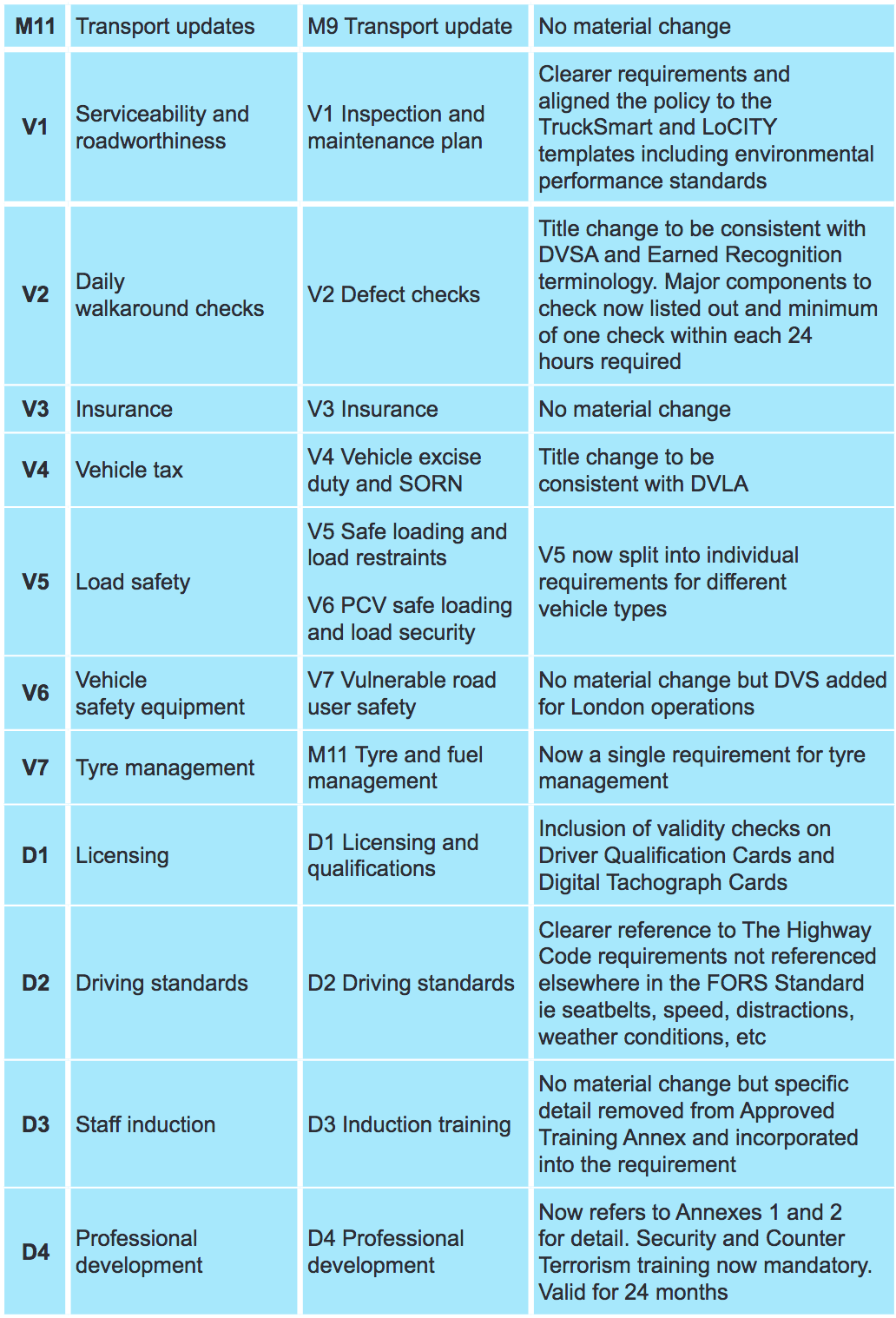
New training requirements have been introduced across all levels of accreditation for both managers and drivers. These are different for drivers of specific vehicle types so it is best to check the training cards at Annexes 1 (for drivers) and 2 (for managers) of version 5 of the FORS Standard. Transitional provisions are in place for a number of new training requirements. In summary, for managers, and for HGV and van drivers, the new training is as follows:

There are transitional periods for a number of the new training requirements. These are as follows:

N.B Security and Counter Terrorism elearning will count against the new mandatory training requirements for Security and Counter Terrorism as set out in Annex 1 of the FORS Standard. It is now valid for 24 months from the original date undertaken. Therefore the validity will be extended on your training records from 12 months to 24 month

The safety eLearning modules from 14 January 2019 are:

Cycle Safety, Van Smart, Smart Driving and Bridge Smart (due to launch soon). These are valid for 12 months and must be renewed every year. After 14 January 2019, Security and Counter Terrorism will no longer be part of the suite of safety eLearning modules. It has become a separate mandatory eLearning module under Bronze D4 and must be undertaken within the past 24 months.

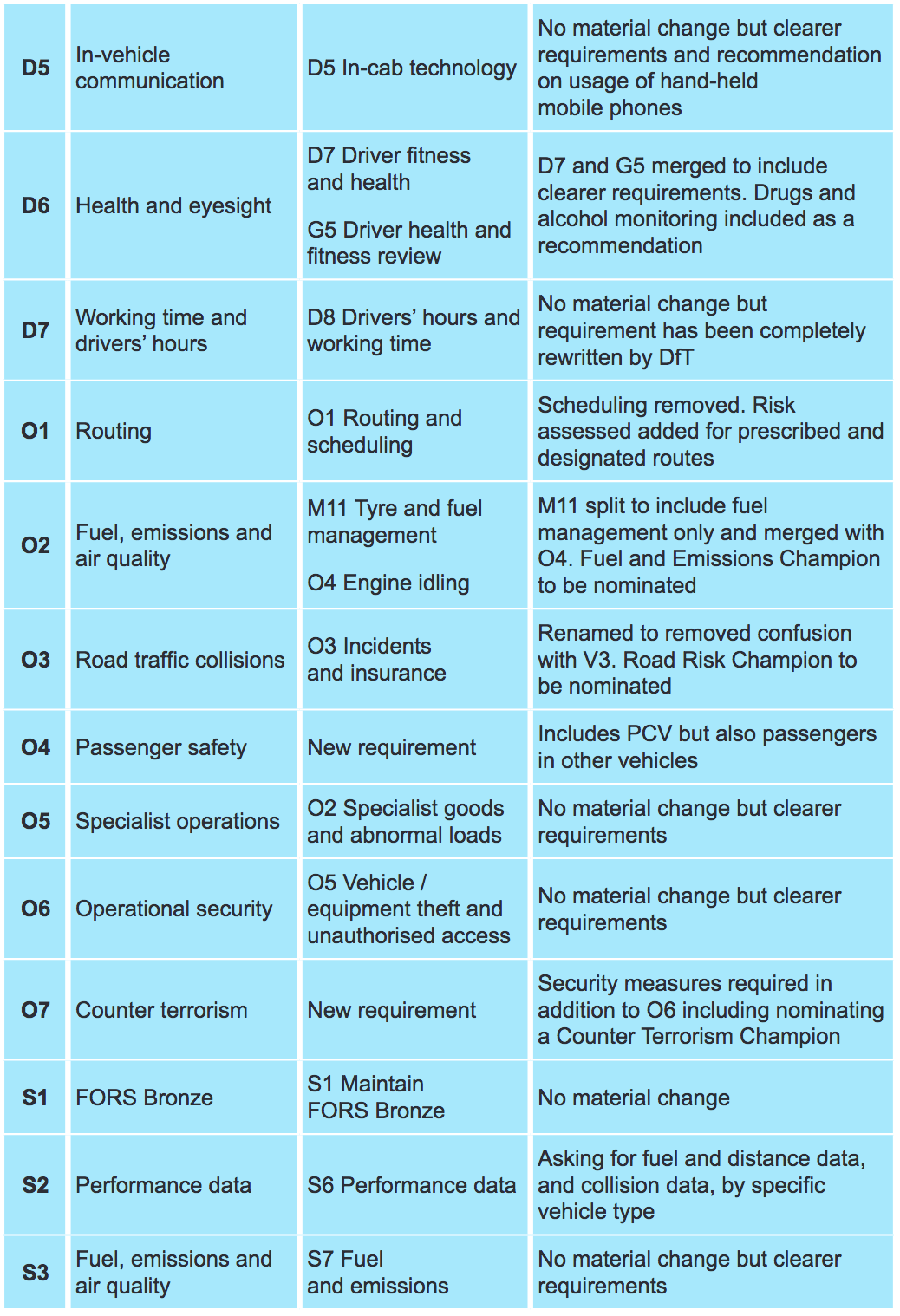
Summary (annex 5)

Have a look at all the summary of changes in annex 5 below.

The FORS Standard version 5 is now available to download on the FORS website here and becomes effective from Monday 14 January 2019 for both new and existing operators.

TMconsultant provide a complete FORS Help package providing you with all the requisite document templates and support required to pass your initial bronze audit. If you need advice regarding FORS please do just get in touch. Here to share the knowledge!


FORS Practitioner

FORS Practitioner award

Congratulations are in order as the FORS Practitioner is awarded to our founder!

Nick’s efforts and dedication in achieving this milestone is certainly worth the recognition, as it enhances his personal development and ours and Link2London’s status within the transport and FORS community. After attending all FORS workshops, Nick has successfully completed the FORS Practitioner programme.

What is FORS Practitioner?

FORS Practitioner is a series of ten workshops covering all aspects of fleet management. Designed to assist transport managers in their busy everyday roles, the workshops provide information needed to boost the performance of a transport operation.

The workshops can also help demonstrate professional development (as outlined in requirement D4 Professional Development of the FORS Standard), and help build your Continuing Professional Development (CPD) hours, as for each workshop equals 2.5 CPD hours. Find out how to claim your CPD hours here.


FORS Practitioner workshops 1 – 10

TMconsultant offer a pre audit FORS help service. For more information on how we can help you pass your FORS bronze accreditation, just click here!

TM1G

TM1G – How Many Hours Should a Transport Manager Work?

TM1G - How many hours should a Transport Manager work? Simply, it depends on how many vehicles are on the margin of an operator licence holder's fleet.

The current regulations are outlined in the Senior Traffic Commissioner’s revised Statutory Guidance and Directions 9 January 2024 


Statutory Guidelines for the Number of Hours Transport Managers Should Work

Motor Vehicles


Proposed Hours (per week)


2 or less


2-4


3 to 5


4-8


6 to 10


8-12


11 to 14


12-20


15 to 29


20-30


30 to 50


30-Full Time


Above 50


Full Time and additional assistance required


Additional hours may be required for trailerstrailers


Looking for an External Transport Manager?

Find an External Transport Manager with our ETM Finder Service

Need Help Applying for an Operator Licence?

Make the process painless with our Operator Licence application service


Statuary Guidance

The guidance explains how the Senior Traffic Commissioner believes that traffic commissioners should interpret the law in relation to the requirements for and on transport managers. The directions are addressed to the traffic commissioners in respect of the approach to be taken by staff acting on behalf of individual traffic commissioners.

They dictate the operation of delegated functions in relation to the requirements for and of transport managers. The role of transport manager is extremely important to an operator and therefore must be able to manage the transport operation effectively in the time they have available. The statutory guidance documents give a broad guideline as to what might be expected in terms of hours worked by a transport manager relative to the maximum number of vehicles authorised for a licence.

Please note that this is a starting point only. The traffic commissioners need to be satisfied that a transport manager is capable of exercising continuous and effective management of the transport operation and will consider each case on its own facts and its own merits.


TM1 - Transport Manager Application

Below is the guidance on what the traffic commissioner is looking for when considering a transport manager's application.

  1. If you will not be devoting the amount of time to the relevant licence(s) as shown in the table above, you should provide the traffic commissioner with a written explanation as to how you will carry out all your responsibilities effectively in the time allocated.
  2. Your explanation should include how you will ensure the operation and management of the following;
  3. Drivers administration - including the checking of drivers' licences and driver CPC qualifications (DQC), ensuring that the retention of drivers hours records (no less than 12 months) and working time records (no less than 24 months) and both are made available upon request;
  4. Drivers management - ensuring compliance with the driving hours rules (EU or Domestic Hours rules); that drivers record their duty, driving time and rest breaks; to download and store digital tachograph unit data (at least every 90 days) and from the drivers’ smart cards (at least every 28 days); ensuring that the following records are retained - drivers’ hours, Working Time Directive (WTD), and that they are available to be produced during the relevant period; to ensure that drivers are adequately trained and competent to operate relevant vehicles and equipment.
  5. Drivers operations - ensuring drivers are completing and returning their driver defect reporting sheets and that defects are recorded correctly and cross-checked, and that drivers and mobile workers take adequate breaks and appropriate periods of daily and weekly rest;
  6. Vehicle administration - including ensuring that vehicle maintenance records to be retained for a period of no less than 15 months, ensuring that vehicles are specified as required and that operator licence discs are current and displayed correctly; ensuring safe loading with appropriate indicators fitted, that tachograph calibrations are up to date and displayed, that there are up to date insurance certificates; a suitable maintenance planner is complete and displayed with preventative maintenance inspection dates at least 6 months in advance, to include the Annual Test and other testing or calibration dates;
  7. Vehicle management - ensuring that vehicles and trailers are kept in a fit and roadworthy condition, that defects are either recorded and repaired promptly and where not roadworthy are taken out of service; to make vehicles and towed equipment available for safety inspections, service, repair and statutory testing at the appropriate times and within the notified O-licence maintenance intervals; to liaise with maintenance contractors, manufacturers, hire companies as might be appropriate.
  8. Compliance systems - including details of training, management, monitoring and auditing showing the role you play including and what authority you have for instance to review any shortcomings such as prohibitions and/or annual test failures. How do you ensure that relevant changes are notified in accordance with operator licence requirements?
  9. Licence administration – ensuring that the traffic commissioner is made aware of any relevant matters within 28 days including convictions and prosecutions of the transport manager(s) or drivers and also of my own resignation should I leave the employment of the operator.
  10. The Senior Traffic Commissioner has also identified some general indicators as to effective transport management which you should comment on:
  11. Knowledge and skills – which require more than just the formal qualification;
  12. Impact – where the individual CPC holder is recognised as a key person within the organisation so that s/he can influence decisions relevant to compliance and authority to deal with external contractors. Their position should reflect the professional and personal responsibility vested in the individual;
  13. Decision making – where the individual CPC holder is sufficiently close to drivers to be able to influence their behaviours and senior enough to influence the deployment of resources and to inform the decisions of the owner/directors/partners.

The above is not an exhaustive list. Transport Managers should also include any further information which is relevant to the operation under their control. The Traffic Commissioner may also require information about the location of the operating centres for which a Transport Manager has responsibility, and whether travelling time will have an impact on thier ability to provide effective management. Transport Managers should therefore also be ready to supply a breakdown of their working week, including details of visits to the operating centres and of travelling time, as this may be requested.

I hope you found this blog useful, if you would like to discuss your options or would just like to have a chat, please do get in touch. Here to share the knowledge!

Need help with your Operator Licence Application? We can help! Get started!

Are you looking for an External Transport Manager for your operating centre? Our ETM Finder Service connects external transport Managers with Operators. Get started!

Are you an external transport manager looking for work? Register on our database.


Are you looking for External Tranport Manager work?

Join our ETM Database

Compliance Auditor Job Opportunities

Compliance Auditor Job Opportunities

Here at TMconsultant we can offer like-minded professionals with freelance compliance auditor job opportunities to help us assist our clients throughout the UK. If you are a qualified or experienced compliance auditor and you are either looking for compliance auditing work we can help.

How does it work?

Once you have completed the application, we will add you to the compliance auditor database. Should a client in your area get in touch, we will simply make the introduction. We don't get involved with payments between you and the client.

How much will I earn?

We charge £700 per audit and take a 25% commission.

Can I get compliance auditing work for the DVSA earned recognition scheme?

Yes, but you must be a DVSA earned recognition scheme authorised audit provider. You can learn about how to become a DVSA earned recognition scheme authorised audit provider here.

Have you thought about teaching Driver CPC?

TMconsultant also offers opportunities for compliance auditors to teach Driver CPC. By becoming one of our consortium members you can teach Periodic Driver CPC training, with all the benefits of being a fully registered training centre with JAUPT, operating under the umbrella of TMconsultant. For more information go here. Alternatively please do get in touch. Here to share the knowledge!

JAUPT announced audit 2018

TMconsultant pass JAUPT announced audit 2018 with flying colours!

Congratulations are in order as TMconsultant pass JAUPT announced audit 2018 with flying colours!

On 24 April 2018 TMconsultant were audited by JAUPT to ensure we fully comply with legislation relating to the DIRECTIVE 2003/59/EC OF THE EUROPEAN PARLIAMENT AND OF THE COUNCIL of 15 July 2003 on the initial qualification and periodic training of drivers of certain road vehicles for the carriage of goods or passengers, amending Council Regulation (EEC) No 3820/85 and Council Directive 91/439/EEC and repealing Council Directive 76/914/EEC.

The main areas of audit consisted of:

  • Centre details
  • Communication
  • Scheme of Control – how we manage the consortium
  • Sampling of records

Arrival Time 08:15 Departure Time 13:15

Executive Summary

Overall, a well structured Centre under the control of an experienced and knowledgeable Primary Contact ensuring appropriate training is being delivered to professional drivers. The Centre was seen to have effective controls in place to ensure standards are maintained.

Would you like to join our consortium and become a member? For more information please do get in touch!

Bus and coach drivers Driver CPC deadline approaching

Changes to Drivers’ hours fines for commercial drivers March 5 2018

The rules will change from 5 March 2018 so lorry, bus and coach drivers who drive tired will be fined for every time they’ve done it in the last 28 days.

If you drive a lorry, bus or coach, you must follow rules on how many hours you can drive and the breaks you need to take.

The Driver and Vehicle Standards Agency (DVSA) can fine drivers up to £300 if they’re caught breaking the rules. They can also be prosecuted or have their vehicle immobilised.

At the moment, DVSA can only fine drivers for:

  • offences committed that day
  • ongoing offences, like manipulating tachograph records, which record drivers’ hours

Drivers will be fined for older offences

From Monday 5 March 2018, DVSA traffic examiners will start issuing on-the-spot fines for any drivers’ hours offences committed in the last 28 days.

In a single roadside check, DVSA traffic examiners will issue fines for up to 5 drivers’ hours offences. It means you could be fined up to £1,500 in a single check if you’ve consistently broken the rules.

It won’t matter if the offences took place in Great Britain or elsewhere.

The rules will also apply to drivers who don’t live in Great Britain. However, they’ll need to pay any fines immediately, before being allowed to continue their journey. DVSA will immobilise their vehicle until they pay.

Fines to deter drivers from not resting properly

As well as giving fines to drivers for recent offences, DVSA traffic examiners have started issuing fines to deal with drivers who don’t properly rest.

Lorry, bus and coach drivers must take a 45-hour rest break at least every fortnight.

Since 1 November 2017, DVSA has started to fine drivers up to £300 if they spend their full weekly rest break in their vehicle in places where it causes a problem. For example, if a lorry driver spends their full break in the cab of their lorry in a layby.

Illegal parking, noise and litter nuisance

Spending the weekly rest break in the cab can:

  • contribute to drivers not properly resting
  • expose drivers to poor living conditions

It can also cause problems in local communities. In some areas, lorry drivers have parked illegally or inappropriately while taking the 45-hour break, and have caused residents to complain about noise, litter and anti-social behaviour.

During 2016, authorities in Kent took action against 3,700 lorry drivers for parking illegally or inappropriately.

Targeting problem areas

DVSA traffic examiners will target places where this is causing the biggest problems, such as residential areas and laybys.

DVSA will also work with its counterparts in other countries to deal with overseas operators whose drivers regularly do this.

Devastating consequences of driving tired

Crashes involving tired lorry drivers can be devastating. Almost a quarter of injuries in accidents involving lorries are fatal or serious.

About 40% of sleep-related accidents involve commercial vehicles.

According to the Royal Society for the Prevention of Accidents (RoSPA), driving while tired may be responsible for:

  • 1 in 5 of all accidents
  • up to a quarter of serious and fatal crashes

Source: Vehicle enforcement data for Great Britain

In addition to the devastation caused to families and communities, road collisions cost the economy an estimated £16.3 billion a year, and add pressure on the NHS and emergency services.

Protecting you from unsafe drivers and vehicles

DVSA Chief Executive, Gareth Llewellyn, said:

DVSA’s priority is to protect you from unsafe drivers and vehicles.

These tougher fines will help us to take stronger action against any drivers or operators who break drivers’ hours rules and will help make our roads safer.

There’s no excuse for driving while tired. The results of falling asleep at the wheel of 40 tonne lorry can be devastating to families and communities. Any drivers breaking these rules is putting other road users at risk and could face losing their licence and livelihood.

James Firth, the Freight Transport Association’s Head of Licensing Policy and Compliance Information, said:

For some years, DVSA officers have been virtually powerless to take effective action against non-UK HGV drivers who may have committed a string of offences in the days and weeks before the vehicle is stopped.

These new powers mean the enforcement authorities will be more able – and more likely – to take action against all drivers who are found to have repeatedly flouted these critical road safety laws.

Transport Manager Recruitment – Employers

Transport Manager Finder Service

Looking for an External Transport Manager (ETM)? Here at TMconsultant, our External Transport Manager Finder Service connects transport managers with employer operators. Every day we collect details of external transport managers all over the country who are looking for work.

How does it work?

We want to ensure we find the right candidate for you, so the first step is to complete the form to the right, providing us with as much information as possible. When we receive the form, we'll get in touch with you to discuss in more detail.

Is there a contract to sign?

Yes, the ETM will supply the contract and both parties will need to agree prior to commencement of any work carried out. For more information and to purchase a copy template of the ETM contract please go here.

What's the minimum the contract be?

We advise a minimum time of 6 months to a year.

How many hours will the ETM be contracted to work?

That depends on how many vehicles are on your operator licence. The traffic commissioner's office statutory guidance provides a broad guideline as to what might be expected in terms of hours worked by a transport manager relative to the maximum number of vehicles authorised for a licence. Please note that this is a starting point only. The traffic commissioner will need to be satisfied that your ETM is capable of exercising continuous and effective management of the transport operation (see below) and will consider each case on its own facts and its own merits.

For a full rundown on the statutory guidance please see here.

How much does an ETM cost?

The cost will depend on how many vehicles you have on your operator licence and what your current Operator Compliance Risk Score (OCRS) is. Prices start at £350.00 for the first vehicle and £100.00 per vehicle after that. For a full rundown of prices please visit our external transport manager prices page here.

What are your charges?

We charge the first-months fee from the ETM as our finders fee. However, this is payable by you (the client) so we can carry out the search. The ETM will start to charge you their fee at the end of the second month. Please click here for pricing. If we are unable to find an ETM you will receive a full refund.

Need more info?

We're here to help so just get in touch, here to share the knowledge!

Employers please complete the form below providing as much information as possible.

DVSA-earned-recognition

DVSA earned recognition

The DVSA have launched their pilot DVSA earned recognition scheme. This can only be a great opportunity for operators and help with road safety!

Forward post from DVSA

DVSA earned recognition: save time and money

We know roadside checks cost you time and money. That’s why we want to make sure we don’t target compliant operators unnecessarily.

DVSA earned recognition for vehicle operators is a new way to prove you meet driver and vehicle standards.

You regularly share performance information with DVSA. In return, your vehicles are less likely to be stopped for inspections.

It’s a voluntary scheme that’s designed to work for operators of all sizes.

Join the pilot

We’re looking for operators with a track record of compliance to join the pilot.

If you join now, we’ll give you more help to get through the process. This level of support won’t be available later, so take advantage of it now.

We’ve published a new guide about how to join the pilot of DVSA earned recognition for vehicle operators. It tells you everything you need to know to get started.

When you successfully complete the pilot

You’ll get automatic entry to the DVSA earned recognition scheme. This will give you the full benefits, such as being:

  • an exemplary operator, and being able to prove this when you bid for contracts
  • recognised as a DVSA-approved operator on a list on GOV.UK
  • less likely to have your vehicles stopped at the roadside for inspections, saving you time and money
  • less likely to have DVSA enforcement staff visit your premises